

Actually I did kind of know I possessed it, I just hadn’t seen it since I moved some years ago and couldn’t think what I might have done with it. Several of my old quilts went to Barbara Chainey for safekeeping but I knew I hadn’t handed this one over. During the Christmas holidays my daughter decided it was time to have a sort out of all her possessions in my loft (she has finally – fingers crossed – managed to get a toe on the housing ladder) just in case there was anything up there she might find useful. Amid a lot of tears a great many childhood friends were bade farewell and sent to the charity shop (both of us trying hard to let go of Tiny Tears dressed in a Brownie uniform lovingly made by my mother some twenty five years ago; we did it . . . but . . . ).
When I went up there to put the Christmas decorations away the place seemed strangely empty. Nearly everything up there was my junk now. So perhaps it was my turn to have a clear out. I started with a couple of promising looking bin bags stuffed in their cardboard removal-company boxes (really must give those back!). In them, wrapped in old sheets, were my grandmother’s linens and . . . the quilt I thought I’d lost. It all came back downstairs and into the washing machine. I had a new roof a few years ago – “no need to empty your loft, darlin’, we’ll keep it all clean” – so everything up there is covered in a thick layer of black dirt.
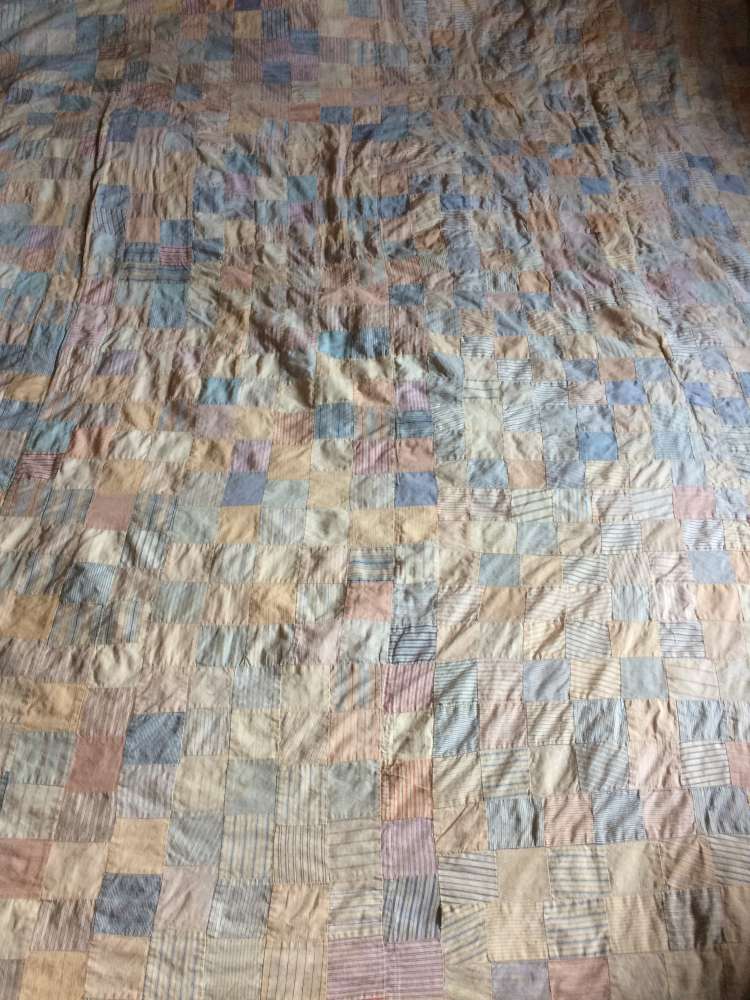
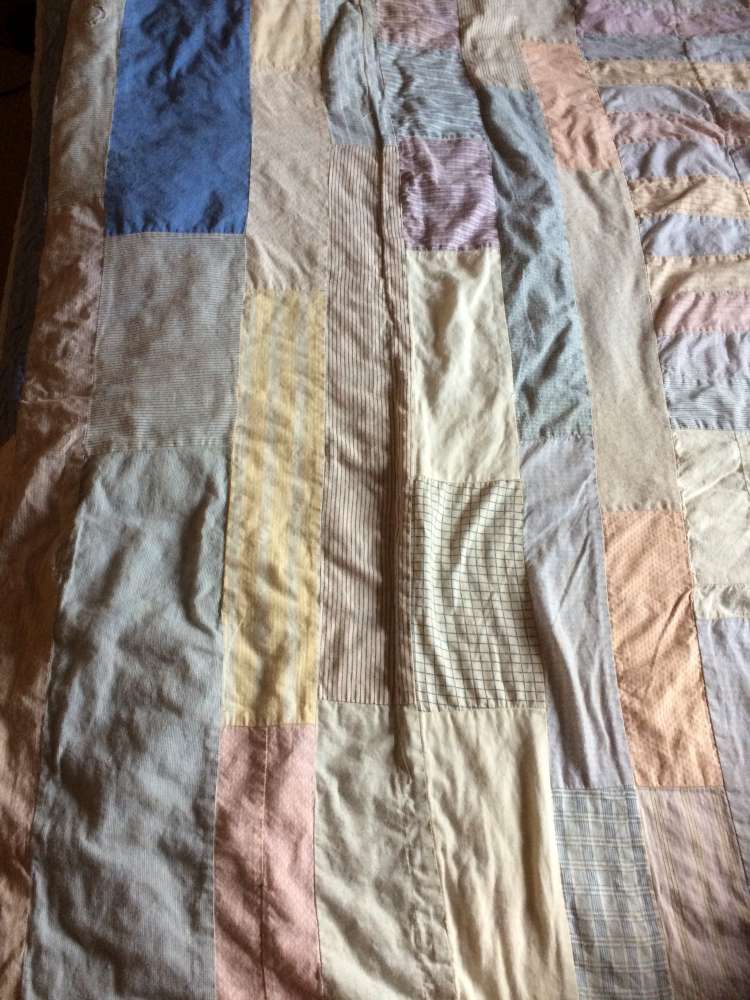
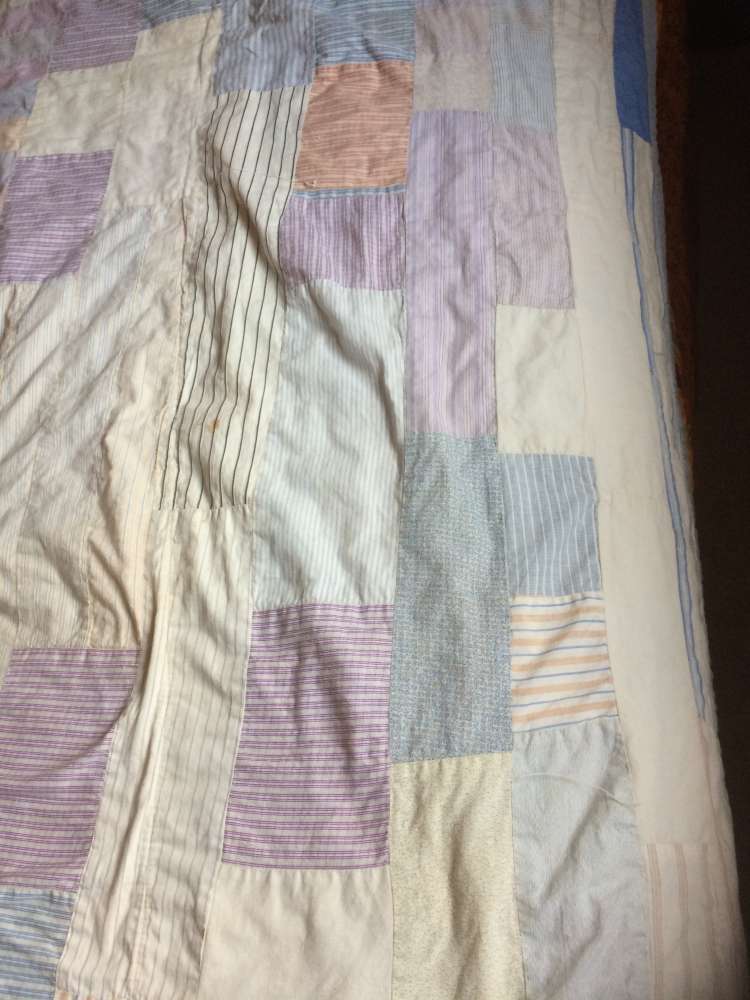
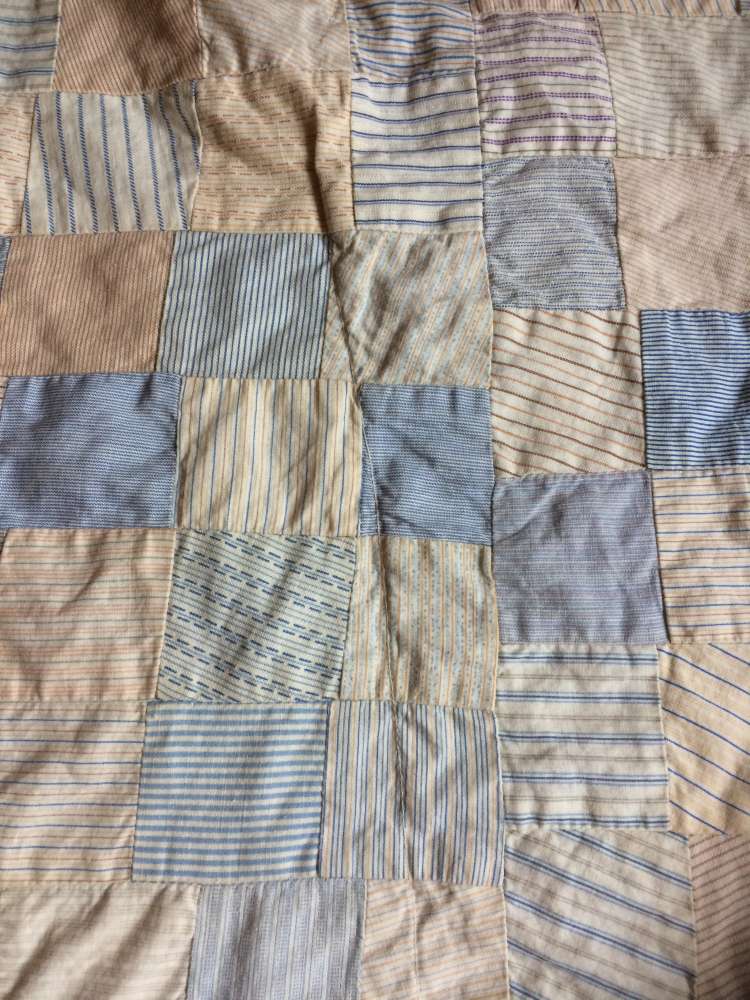
The quilt isn’t actually a ‘quilt’, it’s more of a coverlet, in that it has no wadding. I found it in a bargain bin under a table at an antique fair about thirty years ago and think I paid about a tenner for it. It is made from shirting fabrics – either samples or offcuts from manufacture (or possibly both). The stitching all looks to be machine done and if I had to guess a date I’d probably go for 1930 – 1950ish.
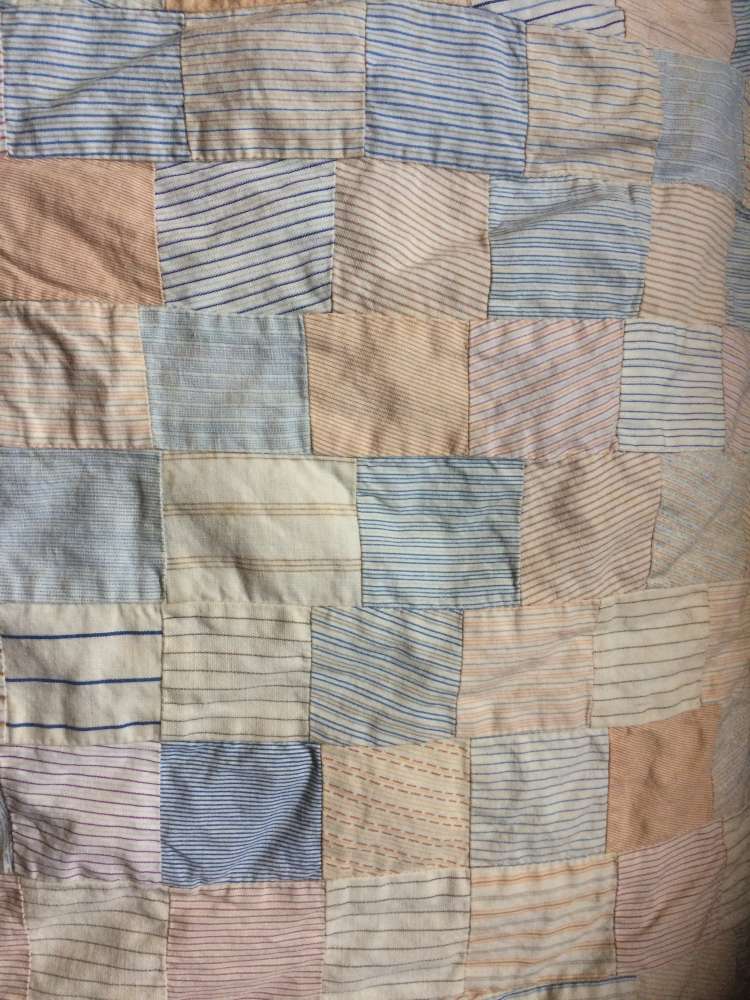
One side is made from roughly cut squares – they are all the same width but slightly different lengths. These have been sewn into rows and then the rows stitched together to build up the top. It almost looks as if the maker started by making her rows a certain length and then decided this wasn’t wide enough for a bed cover and so added more rows in the other direction.
The other side is made from strips of different widths and lengths. There is a centre panel made from strips all cut to the same length and horizontal across the quilt. Other strips have then been stitched together around this panel – but all vertically – to make the top big enough.
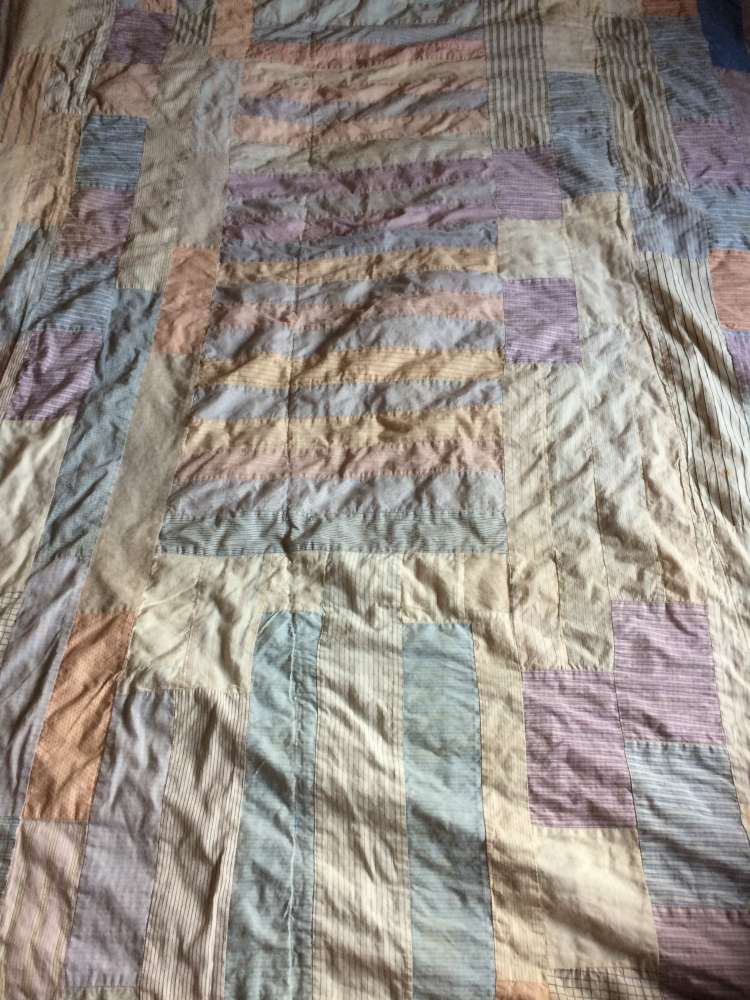
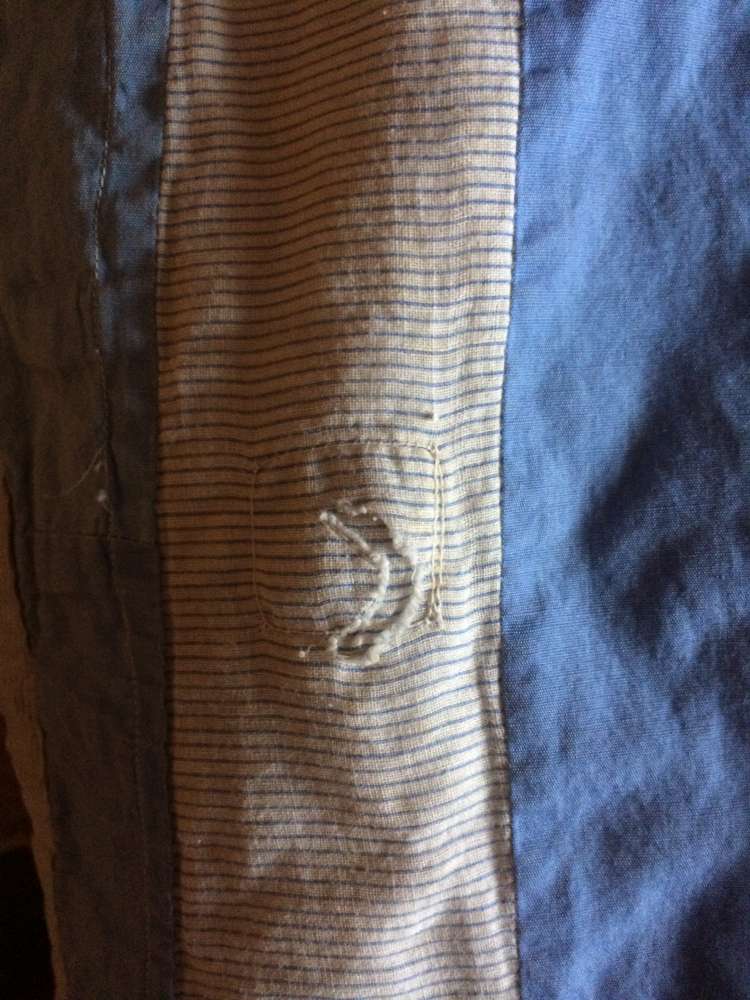
One or two strips have been joined to make a wider strip so it fits and at least one has had a patch very neatly sewn under it to repair a hole.
The layers have been roughly (very roughly) stitched together with a couple of lines of stitch – they don’t go all the way across the quilt and in at least one place have caused the fabric to bunch up and pleat. (We are not alone, nor the first, to suffer from this defect in our quilting). As you can see from the wrinkled state of the (now washed) quilt the two layers are not quite the same size but they have been stitched together roughly and then bound to make a very serviceable single bed cover for the summer.
It may be tatty and stained (probably from being in a linen chest) and nowhere near ‘perfect’ but someone loved it well enough to keep it and wash it regularly; and the maker presumably made it with love for its owner. The least I can do is to keep it clean and loved and used for another generation.
And, when you think about it, it’s a wonderful design for using up scraps . . . One day.




Responses