

In an ideal world our Half Square Triangles (HST) would come out at the perfect size every time, but they don’t do they?
Some patterns, for example, might say cut out one black and one blue square 7” x 7” and trim to 6½” x 6½” whereas others will say cut to 6⅞” x 6⅞” to give you the perfect size.
Sometimes it’s easier to cut your squares out to the nearest inch (or half inch), especially if you are new to quilting and making a HST fills you with trepidation, or you might still be trying to get those ¼” seams on track. I certainly remember that feeling as a new quilter and usually trim up.
I’ve included an example of how to make HSTs as a reminder but there are a few blogs on the UKQU.co.uk website on how to make them. Here are the links.
https://ukqu.co.uk/blog/2020/06/22/skilful-skyful-part-1-half-square-triangles/
https://ukqu.co.uk/blog/2018/01/15/cut-alter-half-square-triangle-hst-tutorial-part-1/
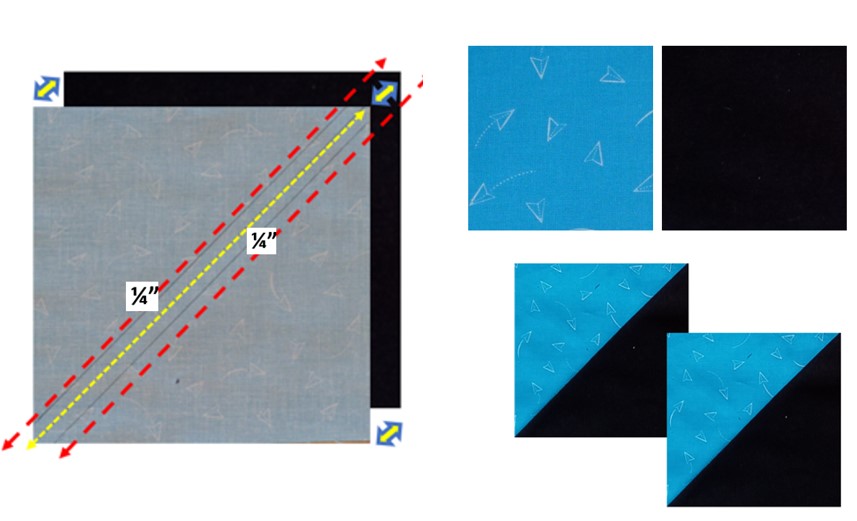
Squaring up HSTs
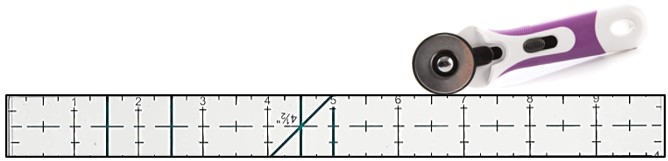
There are several ways you can square up HSTs. A square ruler that has a 45⁰ (degree) diagonal line from corner to corner is ideal but, not all quilters rulers have this. Here are some examples of different rulers:
If your ruler doesn’t have a 45⁰ line across the centre, you could always use TAPE. Place it diagonally corner to corner of a square ruler and use the tape to align the diagonal of your HST.
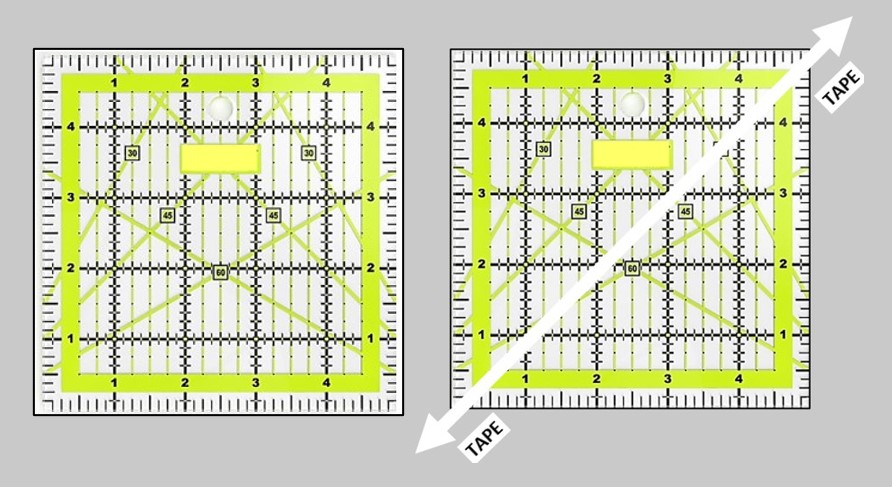
Here are two examples of square rulers that have a 45⁰ centre diagonal line.
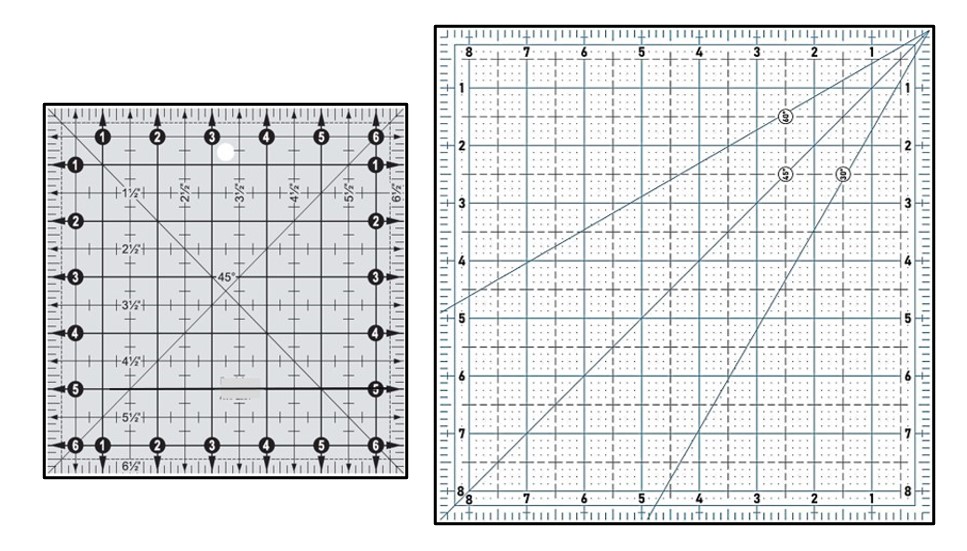
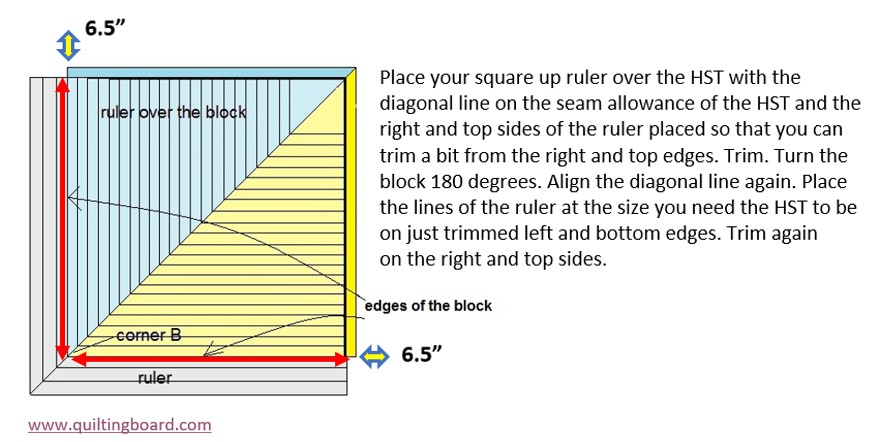
Here are THREE examples of how you can ‘square up’ HSTs. Example 1 uses a quilters square ruler. Example 2 uses a cutting mat. Example 3 uses a piece of paper. For examples 2 & 3 you will also need to use a ruler to cut along. A rotary cutter is best for cutting.
I’ve also included links to some websites that explain it too. Choose which example suits you best and repeat to ‘square up’ all the HSTs.
EXAMPLE 1:
http://quilterbeth.blogspot.com/2017/02/using-half-square-triangles.html
https://busyhandsquilts.blogspot.com/2015/05/squaring-half-square-triangles-tutorial.html
http://www.gigisthimble.com/2013/05/how-to-square-up-half-square-triangles.html
EXAMPLE 2:
If you haven’t got a ‘square ruler’ or can’t work out how to use it for this, you can ‘SQUARE UP’ in other ways.
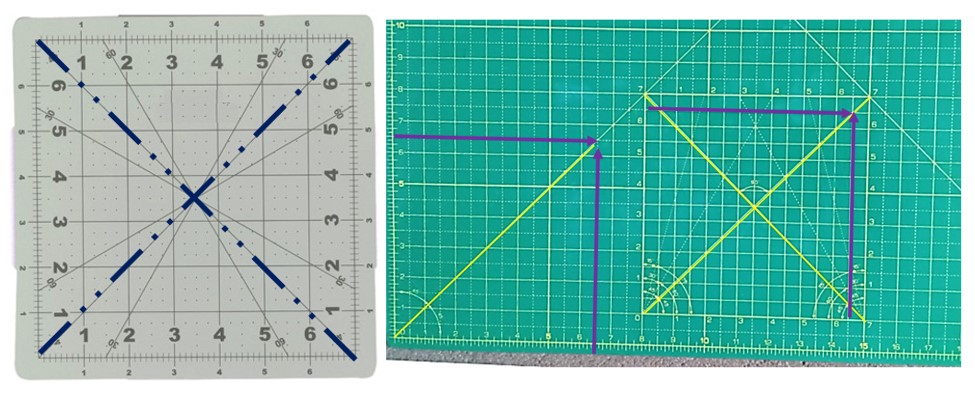
Check if your cutting mat that has 45⁰ line! I’ve included two examples of mats below. The smaller grey mat has a cutting area of 7” x 7” and has a 45⁰ line (blue dash) going in both directions.
The green, 18” x 24” mat has a 45⁰ line running from the left and right of the cutting mat making it possible to square up HSTs to 18” max. It also has a 7” x 7” square section in the centre with a 45⁰ lines shown in yellow.
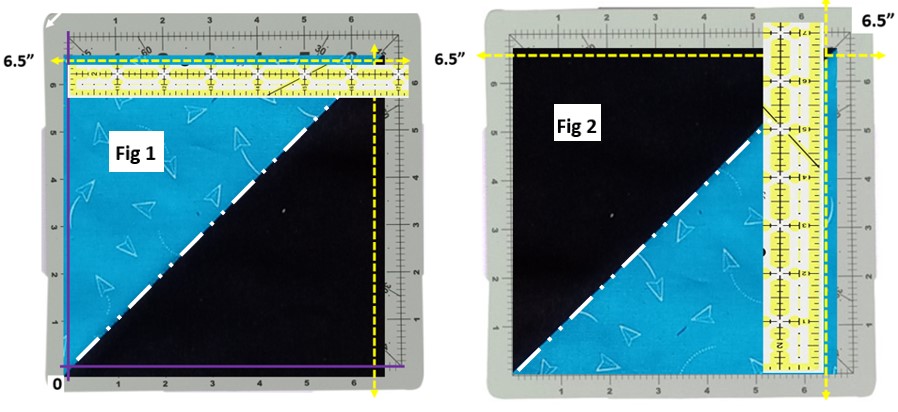
Place your HST with the diagonal seam of the HST along the diagonal 45⁰ line on the cutting mat. It might look skewed but that’s okay – when it’s squared up it will be straight. Use a ruler and cutter to trim across the TOP down the Right-hand side on the 6.5” line (yellow dash) as in Fig 1.
Flip the HST 180⁰ as in Fig 2 and align on the 45⁰ line. Align the ‘cut edges’ across the left side and bottom. Use a ruler and cutter to trim across the TOP down the Right-hand side on the 6.5” line (yellow dash) as in Fig 2.
It should now measure 6.5” x 6.5” square.
EXAMPLE 3:
Another way you can square up a HST is to use a square of paper.
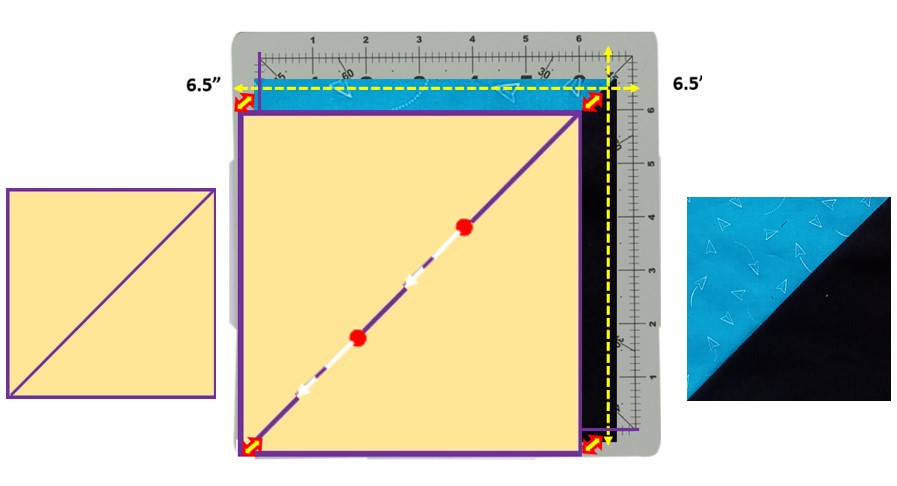
Cut the paper to the size of the HST you want to make, i.e. 6.5” x 6.5”.
Fold or mark across the diagonal line of the paper.
Place the HST on the cutting mat aligning across the diagonal as in example 2.
Align the paper square within the 6.5” x 6.5” cutting mat lines.
Use a ruler and cutter to trim across the TOP down the Right-hand side on the 6.5” line (yellow dash).
Flip the HST 180⁰ and align on the 45⁰ line. Align the ‘cut edges’ across the left side and bottom. Use a ruler and cutter to trim across the TOP down the Right-hand side on the 6.5” line (yellow dash).
It should now measure 6.5” x 6.5” square.
I hope you find this useful. There are some speciality ‘HST’ rulers out there if your budget allows. Ask yourself, how many times you will use them? And, if possible, ask a ‘quilting’ friend who has one if you can try it first.

Carol Lightburn
Twitter: @quiltsewgo Instagram: quiltsewgo
Twitter: @ukquilters Instagram: uk_quilters_united



Responses