

Every so often a member of ‘Our Quilty Pleasures NL’ quilting group puts out a call to make a group quilt of a specific block and size. This time the traditional Log Cabin block was chosen, and, although I’ve been quilting for a few years now, I have never made one! I got so carried away one night in lock-down that I cut out so many strips that I had enough to make lots of blocks – some of which are shown below:
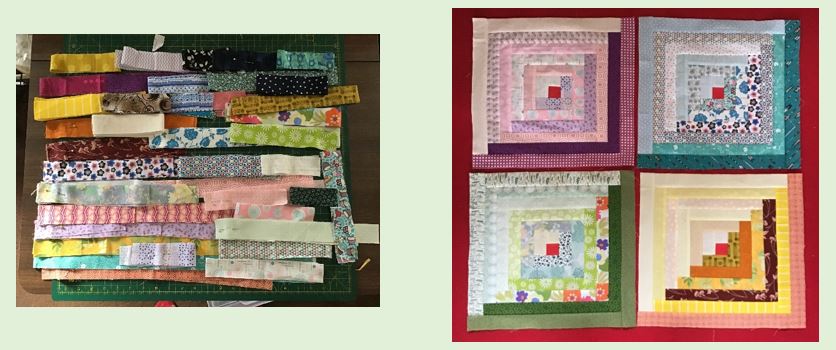
I made 6 blocks out of my ‘strip stash’ and still had some strips left over so I made one last block. I fell in love with it though and decided to keep last one back for me!
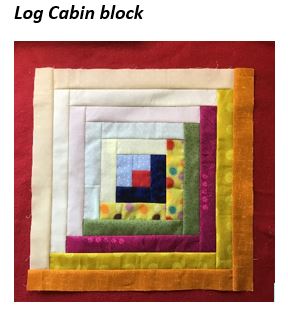
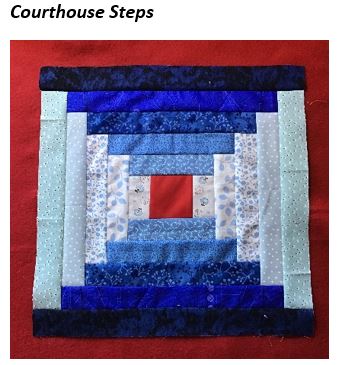
I loved making them so much I suddenly thought, ‘I’ll make a book of sample blocks and this can be my first one!’ So … a little bit of research on the log cabin block and, low and behold, I found there are other blocks in the same ‘family’. I’d never made a Courthouse block either, so, yes, that became number 2 in my Sample Block Book.
I love finding out the background and history of all things quilting. Research into the history shows that Log Cabin quilts have been around for about 200 years, but the inspiration for the pattern possibly dates back even further. In the 19th Century British archaeologists discovered log cabin designed wrappings on animal mummies in Egyptian tombs and on the floors of temples. In the Isle of Man in the early 1800’s the design was known as the Roof Pattern and the design was also seen in embroidery and tapestry work in Scotland as far back as the early 1700’s.
The centre square has significance too. A red centre symbolises the hearth of home and a yellow centre represents a welcoming light in the window. If a Log Cabin quilt with a black centre was seen hanging on a clothesline it signified a stop or safe house for the Underground Railroad. In some quilts the centre square was of a different fabric such as velvet or silk.
There is an amazing array of free block and Log Cabin patterns (and their variations) out there and I came across one called the Cabin in the Cotton block. I couldn’t find any background or history to it other than it being a variation of the log cabin block. I can only guess that the centre square is the ‘cabin’ in the centre of a cotton field and has its origins in 1800’s America.
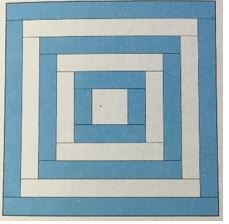
This delightful block is taken from the book Quilting: Patchwork and Applique, published by Dorling Kindersley, October 2014
There were no written instructions on how to put this block together, so I decided to write some for this blog and share them with you all. It’s an easy pattern to do too.
Size: 12½ inch unfinished
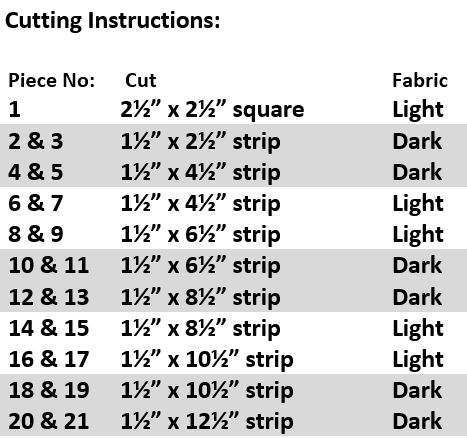
Construction
Tip: accurate ¼ inch seams are needed throughout and pressing at each stage of the construction produces an accurate finish to the block.
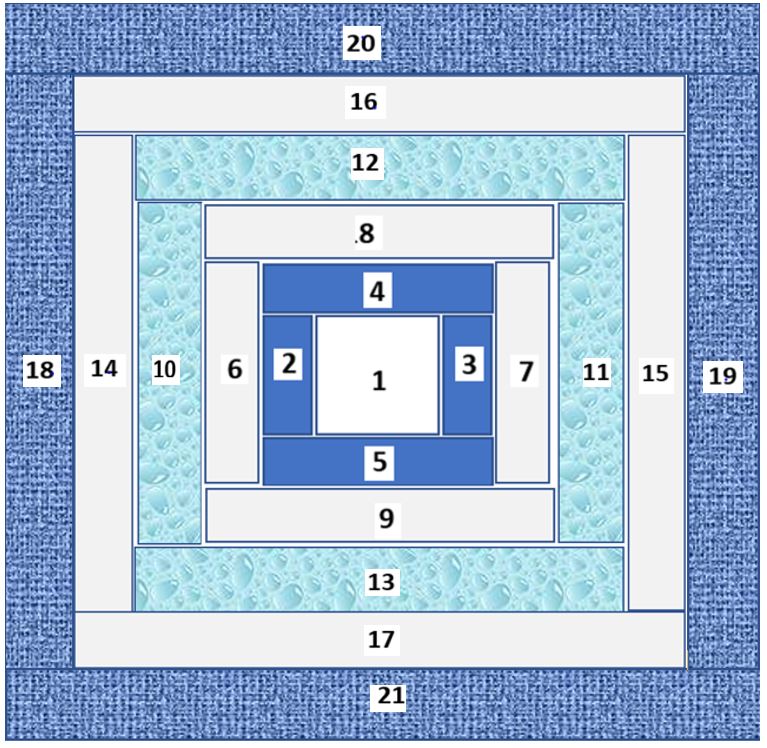
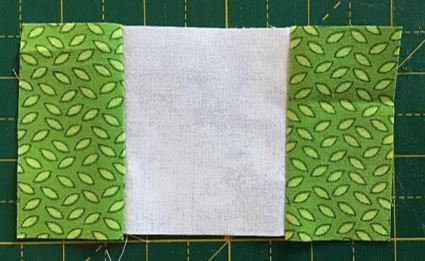
Step 1. With the 2½” x 2½” Light square at the centre, sew ‘Dark’ pieces 2 and 3 to either side using a ¼” seam. PRESS.
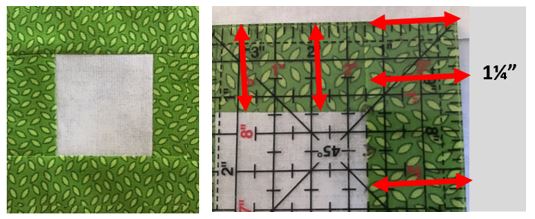
Step 2: Repeat with pieces 4 and 5 by sewing across the top and bottom using a ¼” seam. PRESS again. Square up your block as you go along. Your ‘strip” will now measure 1¼” and you can use your ruler by aligning your ruler along the seam as shown below.
Step 3: using pieces 6 and 7 (Light) sew to the sides of the last ‘row’ using a ¼” seam. PRESS.
Step 4: using pieces 8 and 9 (Light) sew to the top and bottom of the last ‘row’ using a ¼” seam. PRESS.
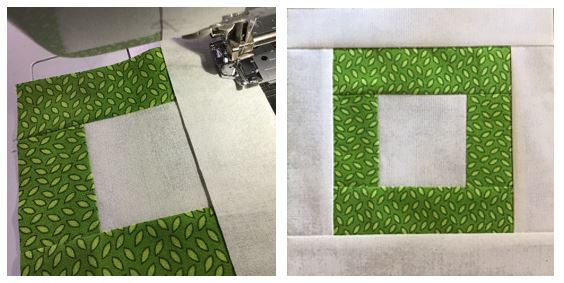
Step 5: using pieces 10 and 11 (Dark) sew to the sides of the last ‘row’ using a ¼” seam. PRESS.
Step 6: using pieces 12 and 13 (Dark) sew to the top and bottom of the last ‘row’ using a ¼” seam.
PRESS.
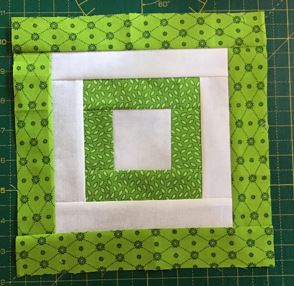
Step 7: using pieces 14 and 15 (Light) sew to the sides of the last ‘row’ using a ¼” seam. PRESS.
Step 8: using pieces 16 and 17 (Light) sew to the top and bottom of the last ‘row’ using a ¼” seam.
PRESS.
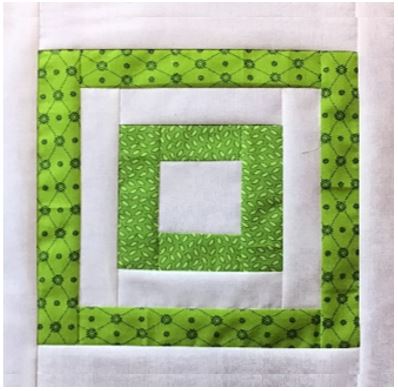
Step 9: using pieces 18 and 19 (Dark) sew to the sides of the last ‘row’ using a ¼” seam. PRESS.
Step 10: using pieces 20 and 21 (Dark) sew to the top and bottom of the last ‘row’ using a ¼” seam. PRESS.

The Cabin in the Cotton block is now finished, and it should measure 12½”. This block really does test your accuracy in sewing the seams so do a ‘sample’ one first to see if you hit the right size. If not, you could cut each strip at 1⅜”and trim down after each ‘round’.
I really enjoyed making these blocks and it made me realise that we sometimes forget about the traditional blocks or make something without realising where their provenance lies.
I recently made a quilt using this pattern without realising that it was a variation of the log cabin block. There is always something new to learn!
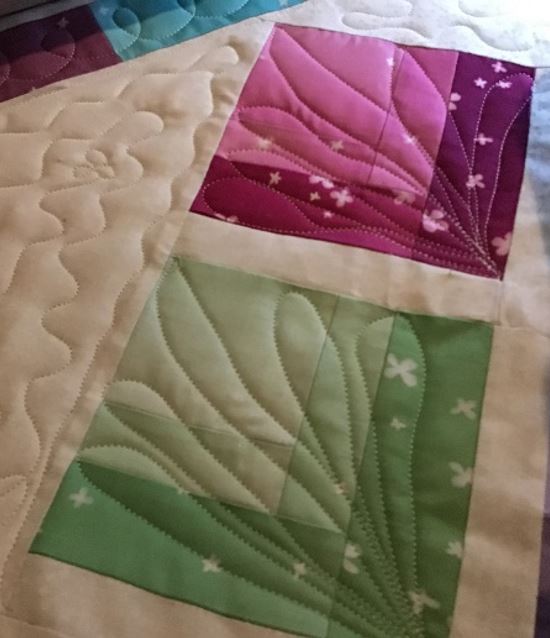
Now …. What will I make for my Sample Block 4?
Happy Sewing everyone, if you do make a block pop a pic on the twitter feeds below.
Carol Lightburn
Twitter @quiltsewgo
@QuiltersUnited




This is a very detailed and extremely well illustrated explanation. I can see I have to do this one.
Thanks Maggie, I always try to make it as easy as possible to suit as many readers as possible. Enjoy making the block.