

Weighted blankets were invented by Keith Zivalich of California. According to Forbes “Zivalich came up with the idea 15 years ago when his daughter draped a Beanie Baby over his shoulder while he was driving. “It was a lizard that was long and hugged my shoulder, and felt pretty cool,” he says. “I thought, ‘Wouldn’t it be great if you had a blanket that hugged you that way?’” Zivalich’s wife created a prototype and then had some made at a factory in Los Angeles. He gave some to friends to try, including a special needs teacher, who immediately discovered how therapeutic a tool the blanket can be.“That extra pressure on the body is helpful for kids of all kinds, but particularly for kids with autism and sensory processing disorder,” Zivalich says. The added weight, he says, causes the brain to release neurotransmitters like serotonin and dopamine that improve moods and induce a calming effect.”
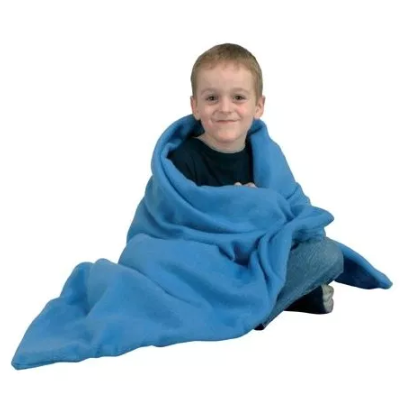
Weighted blankets have been found to be beneficial for all sorts of issues, including insomnia, which is something I’ve always suffered from, so I embarked on a journey to make my own. I have high hopes because the weight makes you feel ‘grounded’ – the best way I can describe this is have ever stuck your leg under a pile of washing on your bed? Or a partner, or a dog, and enjoyed the weight on your leg? It’s also why you put one foot on the floor when you go to bed drunk – It makes you feel present in your body and attached to the earth. Same principal, in a blanket. Or in our case, a quilt, because that’s what quilters do.

There are rules to weighted blankets. Generally, it is 1/10th the weight of the person it’s for, and that weight needs to be distributed across a big enough area to cover them head to toe and fully across. I made mine 7kg (no working my weight out thank you) and it’s just under WOF (44″) and two yards long (72″) If you consider making one for yourself or a child, or anyone else, DO YOUR RESEARCH! Take measurements, check what size a weighted blanket manufacturer would recommend, think about fabrics, the weighted filling, whether you’ll want to wash it. Making one on a whim with guesswork can be dangerous, please don’t approach this lightly. I could give you some links but there’s so much info out there it’ll all be easy to find and you really should look at all of it rather than just a couple of links I give you.
There are alternatives but I used poly pellets. These are the same things used in Beanie Babies. I bought extra dense ones because that way my 7kg was about enough to fill the box a new kettle comes in. 7kg of normal pellets would have taken up a lot more room. And would have been more to squeeze into my quilt!
I was going to make it with squares filled with the poly beads but eventually decided to use whole fabric as there’s less chance of the poly pellets escaping a seam, and I really don’t want a bunch of them rolling around my washing machine! I based it on Rob Appell’s video – two pieces of fabric hemmed sides and bottom , then you sew vertical channels. Put measured pellets into each channel and then sew horizontally to make a pocket for the pellets. Repeat with pellets and horizontal rows till it’s filled up. I made mine in two sections and rolled the edges to create secure hems. I put snap tape on both halves. Mostly I wanted to be able to wash it in two sections. I have a 9kg washing machine but I still doubt it would appreciate a 7kg blanket. Plus you always should put at least two things in the machine to distribute weight evenly, I figure washing each half with some towels separately would be kinder on my washing machine. Also I’ll be putting it in an old duvet cover and machine sewing the top shut, I really am worried about those pellets escaping – better safe than sorry.
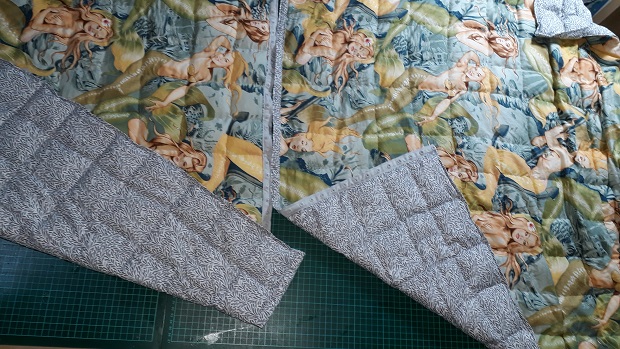
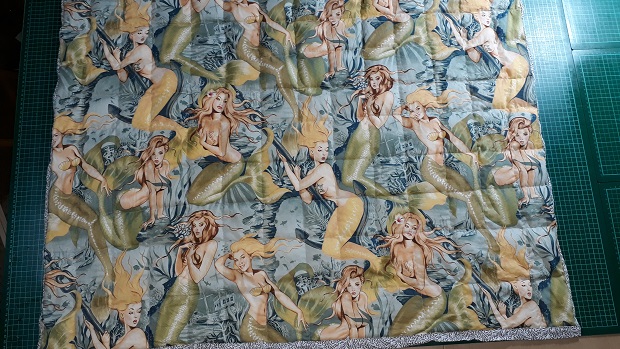
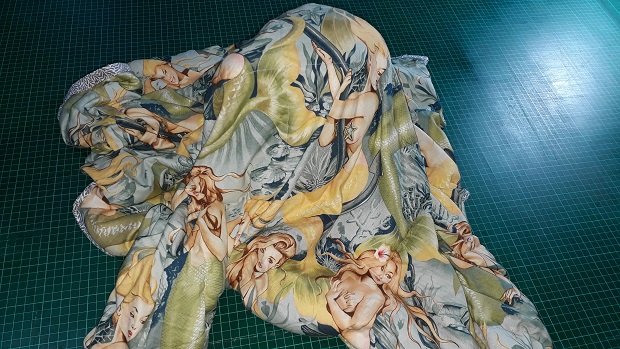
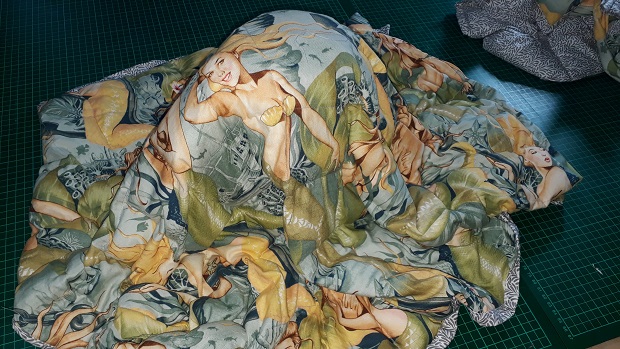
One thing I did learn was not to make each ‘pocket’ too big. I started with channels about 6″, and I don’t know how well you can tell, but when draped (over my kettle) it kind of went… flomp. I went back and sewed new lines on it between each vertical and horizontal channel to make each pocket approx 3″ square, and now it’s more… floof. You know what I mean 😉 It distributed the weight and the pellets far better. Had I stuck with the 6″ pockets I would have laid it over me and all the pellets would have fallen down my sides. ̶Li̶k̶e̶ ̶m̶y̶ ̶b̶o̶o̶b̶s̶
Also, get out your walking foot! It’s a whole hunk of quilt and those pellets will drag it down while you’re sewing. I put a small table in front of my machine to support some of the weight as I went.

What will I do with the blue version?
I used two yards of the mermaids and I put a pretty grey print on the back – that’s four yards knocked out of my stash! It’s a very straightforward process that’s far more complicated to actually do. 99% of my time was corralling poly pellets and keeping them out of the way of my sewingmachine foot. I broke three needles accidentally hitting a pellet.
But most of all it was finally something to use my gorgeous Alexander Henry Sea Sirens fabric on. Those nekkid mermaids are huge, about 12″ tall, so cutting it up … well it wasn’t going to happen. I do have a yard of the blue version left though….
If you are interested in making one, as I said, do your research first. The poly pellets can be bought from ebay I paid about £30 for 10kgs so I have some left over for weighting dolls and such. There are hundreds rolling around inside my son’s divan bed though. Much like confetti and guinea pig poop, no matter how much you clean you keep finding them everywhere!
The finished weighted quilt – the indoor pictures have more accurate colour.
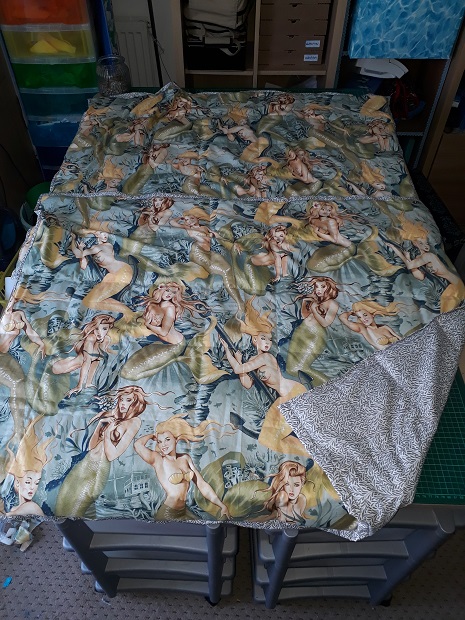
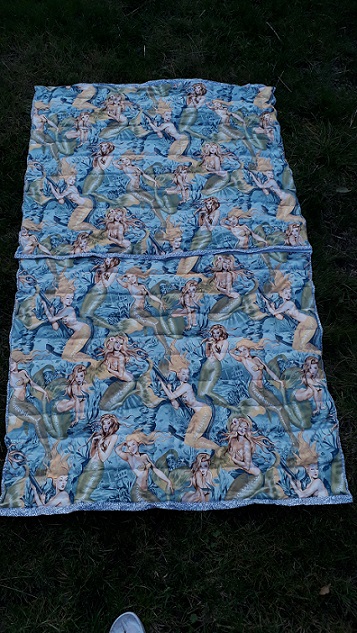
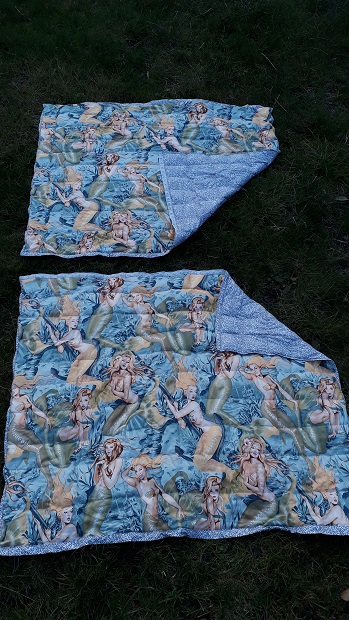
Well, quilt tried! It’s like being hugged and it made me feel really comfortable. It might even have helped me get to sleep! It’s hard to describe how the weight helps, but it does make you feel safe somehow.
Also, I have to apologise to my team – #TEAMMEL In the UKQU Mini Swap Winter 18 – the mermaids weren’t for any of you, I was just teasing. Most of the team loved a bit of risqé nekkid mermaid though, I’ll have to bear that in mind if I get any of them as a partner next swap!
If you have any questions or comments, please add them below 🙂



Have heard a lot about weighted quilts, have had friends ask me to make them, but the research about child weight to quilt weight was a step too far for my calculator & brain. I have heard it helps with SEN (Special Educational Needs) pupils, but was not prepared to endanger them (some of my friends children) by getting it wrong. So why is weight important, why is it soothing? I do the opposite in the winter, heavy down winter quilt goes on and I get pains in my feet, cramps in my legs, breathlessness, because of the weight, unable to cope with the weight, I throw the wretched thing off & get a towel from the bathroom as a blankie so I don’t freeze 🙁
Thank you, useful and you have reminded me that my daughter would like one of these, I rather fancy the idea as well.