

Earlier this year my brother, a widower, announced he had ‘met someone’. Not only that but they were getting married the next month. Cue much family panic – insufficient time to buy an ‘outfit’; how grand a wedding, do we need a hat? Most of this panic was from our little sister and the more girly of our nieces and great-nieces. My brother, when asked, said vaguely (his default position) that he thought he had a suit somewhere. He rather thought his bride-to-be had a dress of some sort . . . The rest of the family settled on ‘vaguely smart’.
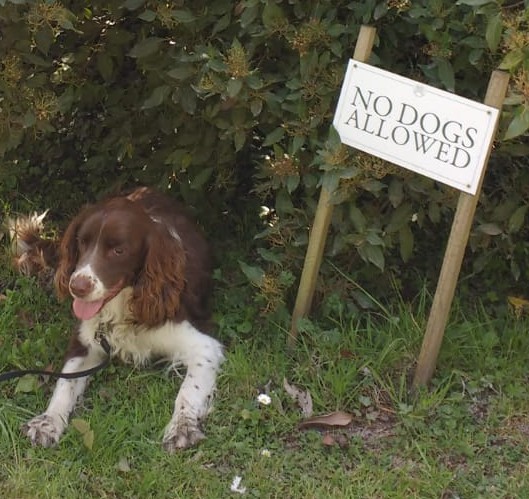
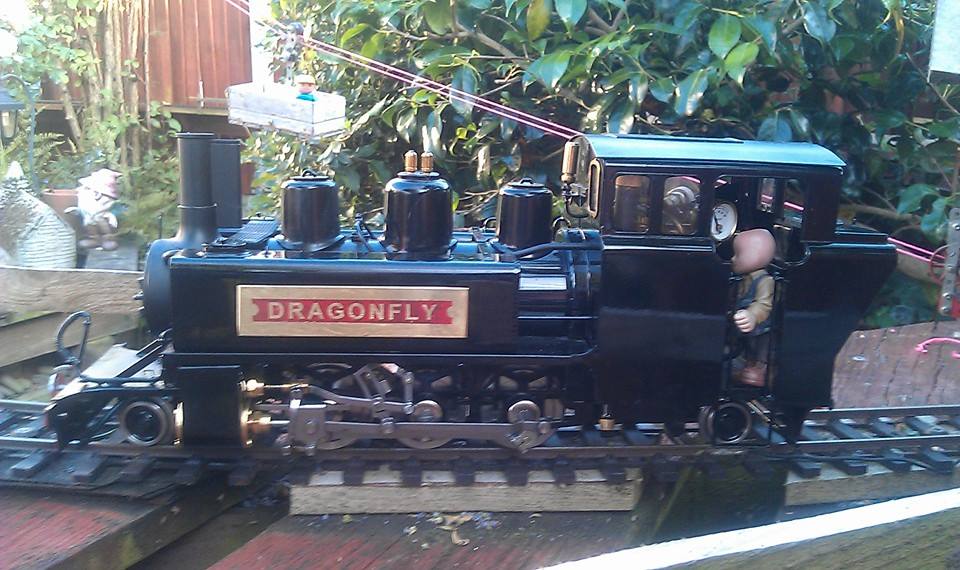
My brother is a vicar, his bride-to-be is a vicar, his youngest daughter – also a vicar. Already there is a surfeit of vicars at this wedding. After much consultation with dioceses and bishops and whatnot my niece is given permission to marry her father (another cue for much family merriment) at the bride’s mother’s parish church aided by the vicar of the parish and one other – even more vicars! At which point I receive a wheedling email from said niece – “I don’t suppose you could . . . make a wedding stole for the ceremony?” It has to be white. It has to have a silver cross and two interlocked gold wedding rings. It has to have a photo of one of my brother’s model steam trains and a photo of the bride’s dog! OK. I find myself agreeing. An email with suitable photos is sent in reply.
No turning back now. Somewhere I have a pattern for a stole as I dimly remember making at least one for my brother when he was ordained. Much rummaging in cupboards later and I have found not one, but two, paper stole patterns. One I think probably taken from a commercial stole and the other from a book – The Patchwork Pilgrimage by Jill Liddell. They are broadly similar so I pick one at random and put the other back. Did I draw it with or without a seam allowance? It helpfully doesn’t say. I decide I didn’t as it might end up a bit skinny if I had. This time I write on it “No seam allowance” and put it safe.
Now for the photos – again, somewhere I have some printable fabric. More rummaging in other cupboards later and one solitary sheet of (probably) cotton printable is found. No packaging or instructions however so we’ll just wing it. Look at the photos and decide to crop them to get rid of extraneous background. Manage that without too many disasters. Now I just have to print them onto the fabric. Decide to be sensible and print onto paper first to test it. Insufficient ink in the printer and print out is all striped. Oops. Good job I didn’t print straight to the fabric. Recharge the printer. Then realise I need to print the photos a specific size so they fit onto the stole. Change the printer settings and try again. Work out – and write down – how the paper / fabric needs to be fed into the printer so the photos are printed separately and on the fabric side of the printable. Fingers crossed; press ‘print’. Phew. Another milestone reached. Put the printed photos safe.
Find the stole pattern again. It needs to be white, but maybe not just plain white, maybe I can use up some of my stash and scraps of white, white on white/cream prints and nearly whites in some sort of design such as . . . (lightbulb moment) Flying Geese. But the stole is not straight nor an even width – it tapers and is curved. But I could foundation piece those Geese. Yes, I hate foundation piecing but . . . needs must. So . . . find some medium Vilene. Draw around the stole pattern and cut it out. Label the pieces so I don’t end up with two left-hand sides (shades of needlework at school when I made two left legs for my pyjamas). Place the photos in position and pin them loosely. Mark (on the wrong side) where that first seam needs to be to join the photo to the first Geese (Goose?) unit. Remove the photos and carefully draw Flying Geese up the two pattern pieces making sure the points are in the middle each time. Decide not to do them all the way to the end – they’ll be wasted on the shoulder part and it might hang better anyway if that is just plain fabric – so ‘only’ 14 units each side.
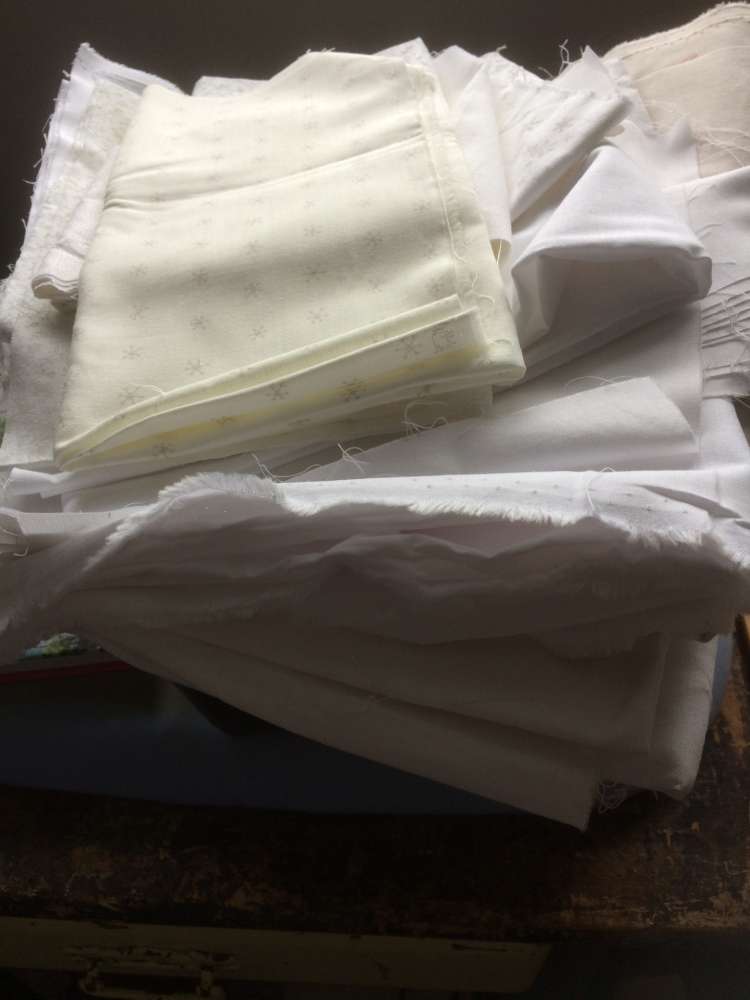
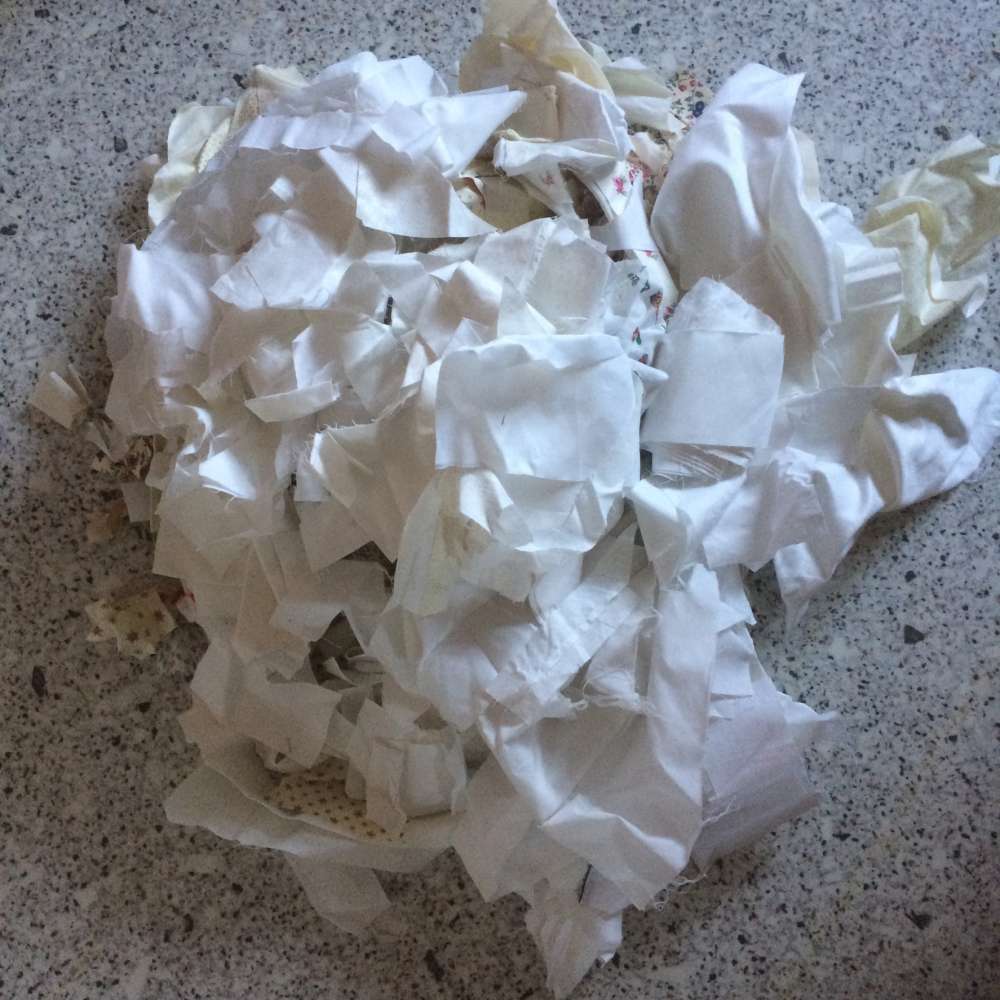
Next step is to tip all the white scraps and larger bits out of their bags and boxes and press the more crumpled pieces that look as if they might be the right size. Decide to do the ‘Geese’ (larger triangles) in scraps and the ‘sky (smaller triangles) in plain. Hoorah, we have a plan!

Over to the trusty Singer to stitch, trim, flip, press, repeat; having first bordered those photos with white and placed them carefully, in the right place (matching that first seam line) on the ends of each piece. Finish each piece with a strip of plain white and a final press.
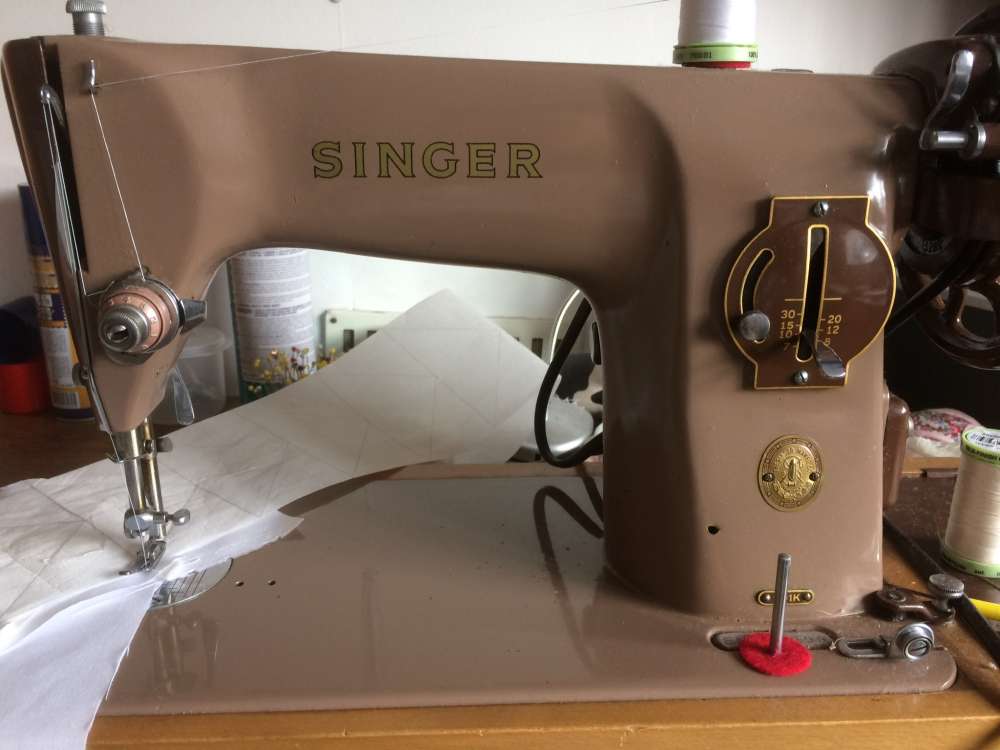
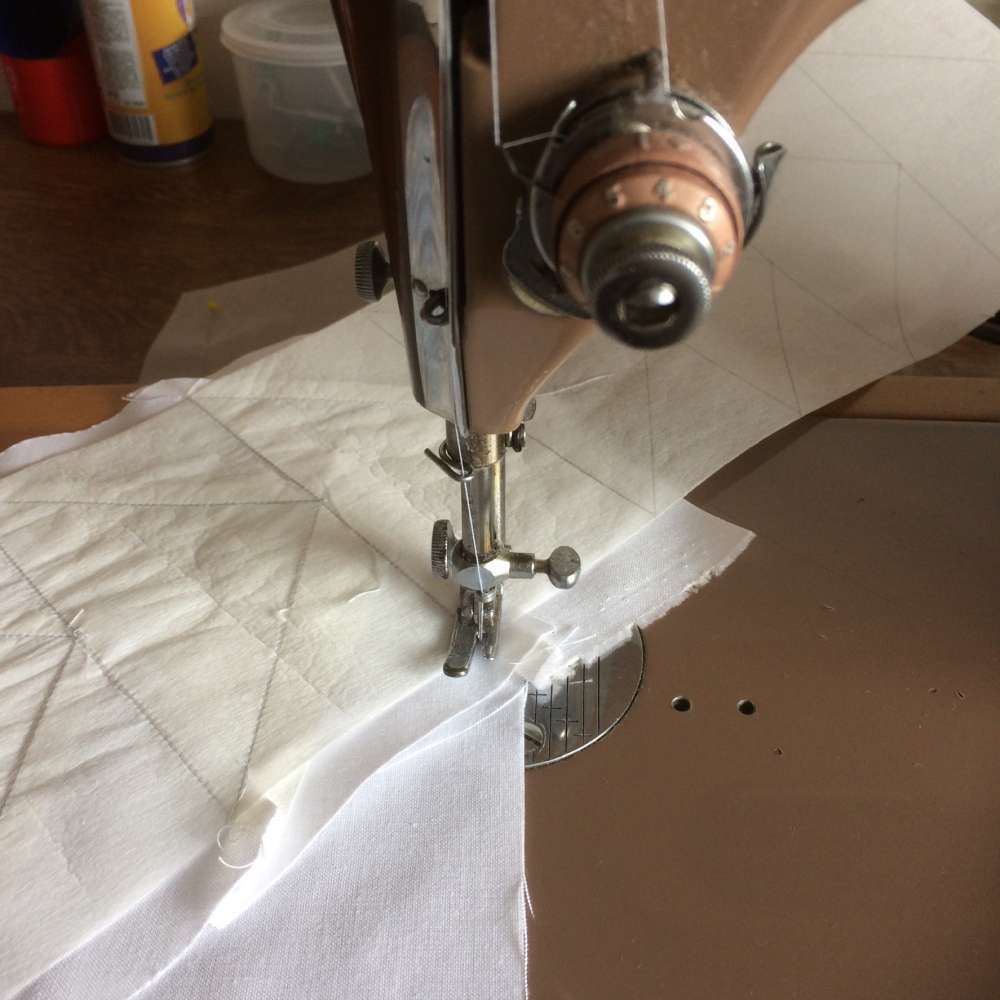
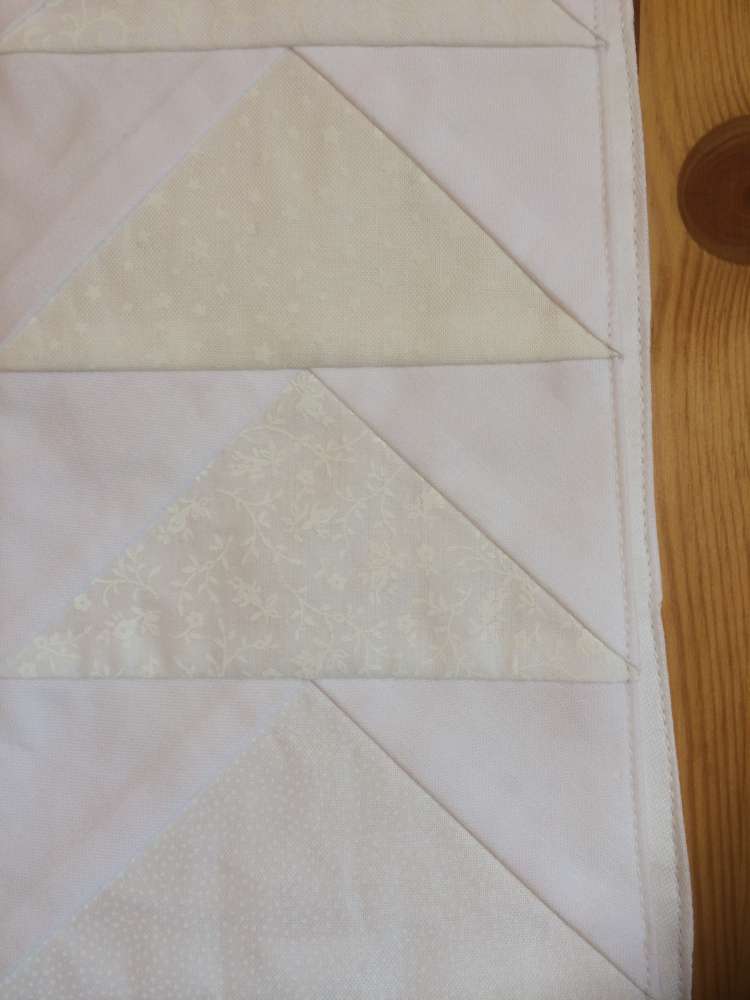
Now comes the next tricky bit. Two gold rings and a silver cross (fortunately no partridges in pear trees). Find some silver ribbon and some (wide) gold bias. After more cupboard rummaging I locate the ¼ inch wide Bondaweb for doing stained glass and Celtic applique. Fold the bias in two and sandwich the Bondaweb between – I now have narrow gold bias. Work out where on the stole this motif is going to go and draw a square-ish shape that size.
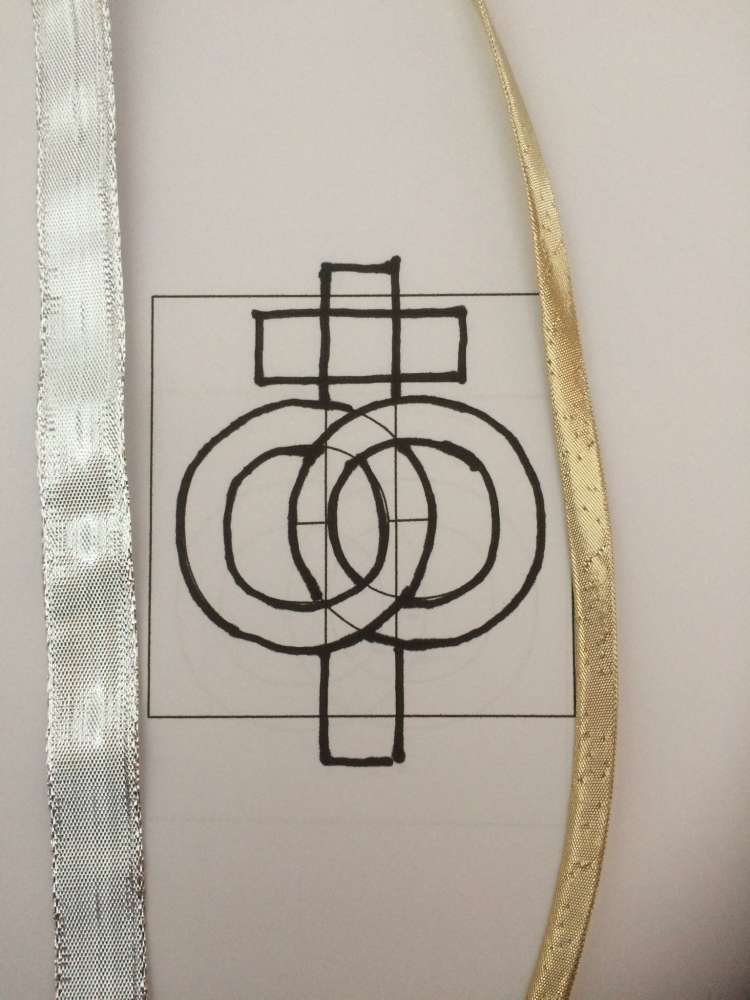
Draw a cross and interlocking rings within that shape, then go over it with a heavy black line that will show through all the layers.
Use it to cut the ribbon to shape and size, remembering to add a bit to fold over at the ends.
Cut two lengths of gold bias to make the rings.
Back the ribbon and bias with Bondaweb – carefully!
Put the drawing under the stole and position it, then pin in place.
Take it all to the ironing board and check the iron is not on super-hot or steam.
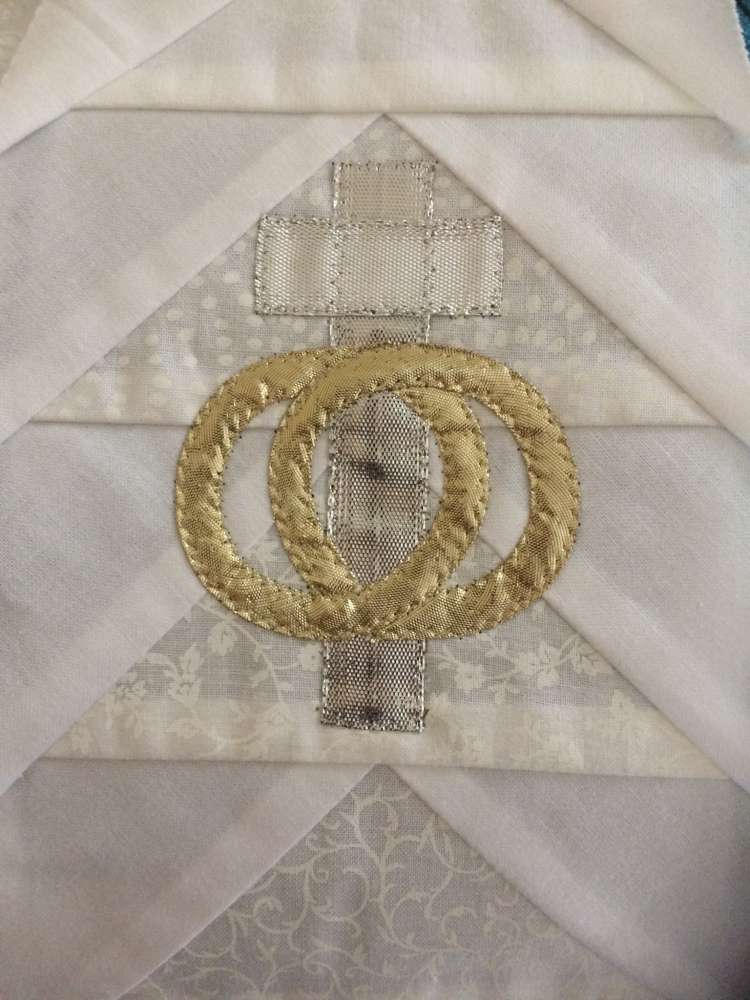
Place the silver ribbon first, cover with baking parchment and give it a quick press. It is ok, so add the next bit of ribbon and give that a quick press. It too is ok so I can press them properly into place.
The rings are fiddly. I don’t do fiddly, I’m not very dextrous, but I will not be beaten. I finally manage to wrestle two lengths of bias into ring shapes that under- and over-lap with the joins hidden under the over-laps.
A quick press to make sure all is ok and then a final press to secure it all. And breathe.
Then put some invisible thread into the alternative machine (it does fancy stitches) and zig-zag around all the shapes to hold them in place.
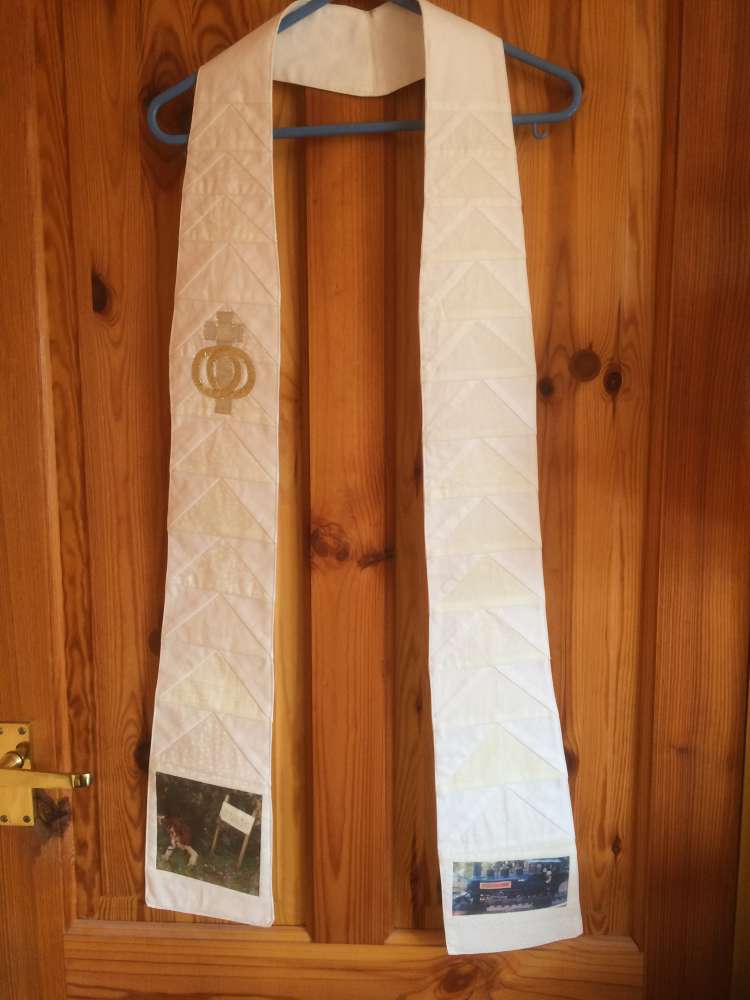
We’re on the final straight; time to cut two wide strips of plain white for the back of the stole. Join these at one end and join the two stole pieces at the narrow (neck) end. Place them right sides together. Pin everything like mad. Stitch all the way round – don’t forget to leave a gap to turn through – put pins at right angles to remind myself to leave that gap on the inside neck line. Back to the trusty Singer and stitch carefully, next to the edge of the Vilene, all the way round – except for that crucial gap. Trim the seam allowances but leave a bit extra at the gap. Turn right sides out and press the edges. Press the fabric under at the gap and press the rest carefully. Then its back to the Singer to topstitch right around the edge, including the gap, to secure everything. Stand back to admire – and realise I’ve put the cross and rings on the ‘wrong’ side – I had meant to put them on the side with the smaller photo. Only I know this (and now you do too) so I decide it doesn’t really matter, although I know it will bother me every time I look at it! Also realise the train photo is wonky. Bother. Oh well, maybe no one will notice?
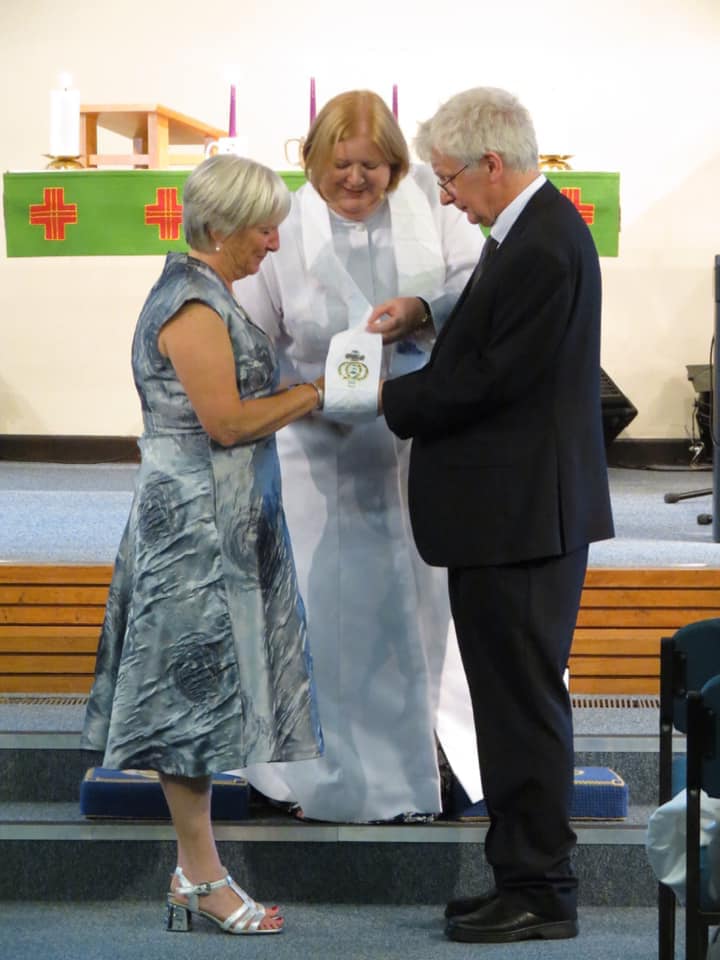
A few days later and the Great Day dawns; I meet my niece early to hand over the stole. My brother knows nothing about it. The idea is that they will be given it to use in their church after the wedding ceremony. Bride and groom meet at the altar and my niece steps forward wearing the stole – bride and groom peer at it, niece holds it out for closer inspection whereupon they and everyone in the front couple of rows collapses in fits of helpless laughter. Which sets the tone for the rest of the ceremony really – it was a very emotional occasion as we remembered my brother’s first wedding and his first wife who had died so suddenly and unexpectedly, and our joy that my brother now seemed to have found someone he could spend the rest of his life with – laughter seemed so much better than tears, even if it did verge on the mildly hysterical from time to time.


Chris, what a wonderful story, you are so clever to have made such a meaningful stole. I wouldn’t have known where to begin. Congratulations to your brother and his new wife.
Thank you, Ami. I had a lot of help – from the book I had and from my niece.